

“Why is the sky blue?”
“Why do ants walk in a line?”
“Why can’t I see the wind?”
If you teach little learners, you hear dozens of these questions every day. In the middle of circle time. While you are helping with a zip. Sometimes, it feels, without a pause for breath.
On a busy day, these questions can feel like interruptions. But every “why?” is a small window into a growing mind. It is a child saying, “I want to understand the world.” When we welcome that question instead of rushing past it, we are doing some of the most meaningful teaching of the early years.
This guide is for preschool teachers who want to turn everyday questions into everyday learning. You will find simple responses, classroom ideas, activities and a ready-to-use weekly plan you can start with on Monday.
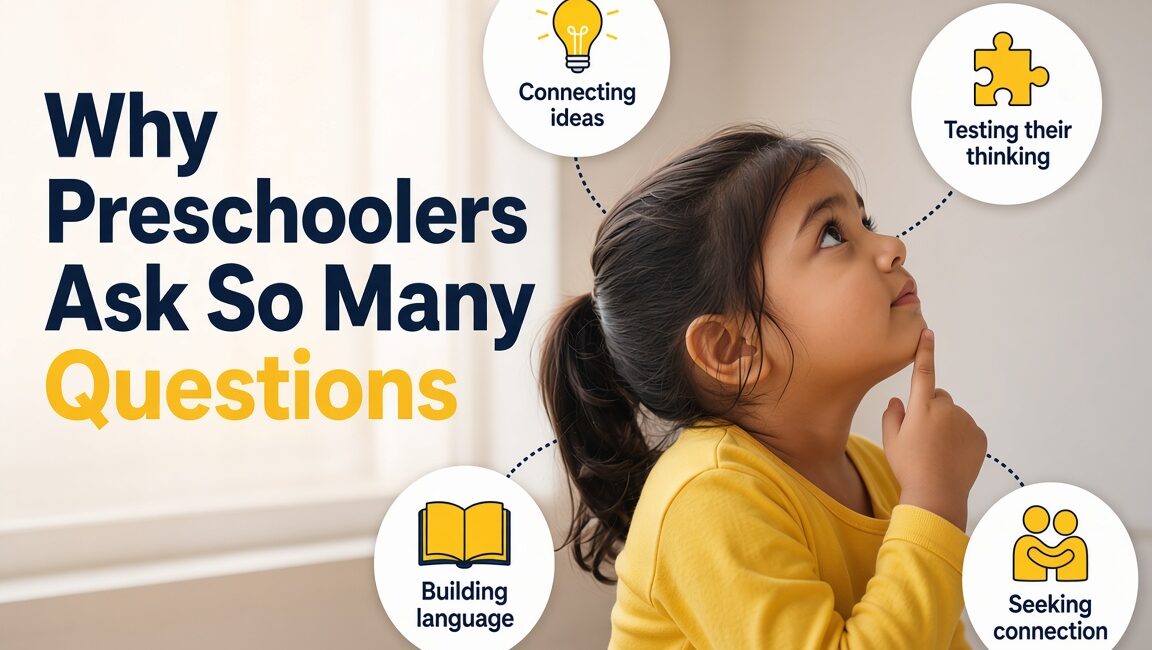
Why Preschoolers Ask So Many Questions
Between the ages of three and six, children are making sense of language, cause and effect, people, nature and themselves, all at once. Questions are their most powerful learning tool.
When a child asks “why?”, they are usually:
- Connecting ideas – linking what they already know to something new
- Testing their thinking – checking whether their guess about the world is right
- Building language – practising how to put thoughts into words
- Seeking connection – inviting you into their thinking and wanting to be heard
So the constant questioning is not a phase to “get through”. It is learning in action. A curious child is an engaged child, and an engaged child learns more deeply. This is also why the NEP places strong emphasis on play-based, activity-based and inquiry-based learning in the foundational stage.
What to Say When a Child Asks “Why?”

How we respond in the moment decides whether a child keeps asking. Here are teacher-tested responses you can use straight away.
To show you value the question:
- “That’s a wonderful question. Let’s think about it.”
- “You noticed something interesting!”
- “I love how you’re wondering about that.”
To get children thinking before you answer:
- “What do you think?”
- “Why do you think that happens?”
- “What have you seen before that’s a bit like this?”
- “How could we find out?”
When you don’t know the answer:
- “I’m not sure. Let’s find out together.”
- “That’s a tricky one! Shall we look it up after snack time?”
When you can’t stop right now:
- “That’s too good a question to rush. Let’s put it on our Wonder Wall and talk about it at circle time.”
A quick tip: try to avoid “Because I said so”, “Not now” without a promise to return, or long explanations children can’t follow. A short, honest answer followed by “Shall we look at it more closely?” works beautifully at this age.
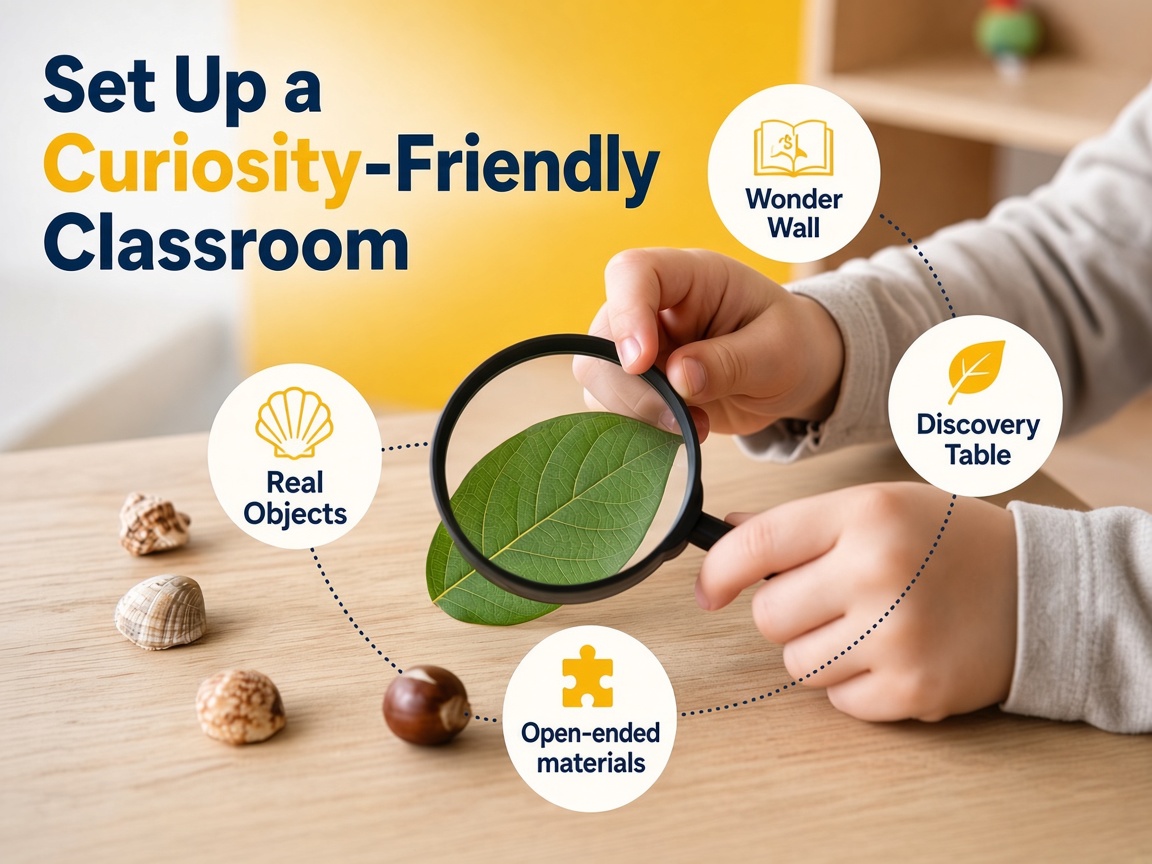
Set Up a Curiosity-Friendly Classroom
The classroom speaks to children before you do. A few small changes can make your room a place where questions come naturally.
- Wonder Wall or Question Jar: Write down children’s questions (with their names) and display them. Revisit one each day during circle time. Children feel proud when their questions are taken seriously.
- Discovery Table: Keep a small table with leaves, seeds, shells, stones, feathers and a couple of magnifying glasses. Change items every week.
- Open-ended Materials: Blocks, clay, loose parts, cardboard and recycled materials invite children to build, test and ask “what if?”
- Real Objects Over Pictures: Wherever possible, let children touch, smell, hold and observe the real thing.
- “Our Thinking” Display: Show children’s guesses, drawings and findings, not just finished craft work.
- A Little Free Time: Keep 10–15 minutes in the day for free exploration. Some of the best questions appear when children aren’t being told exactly what to do.
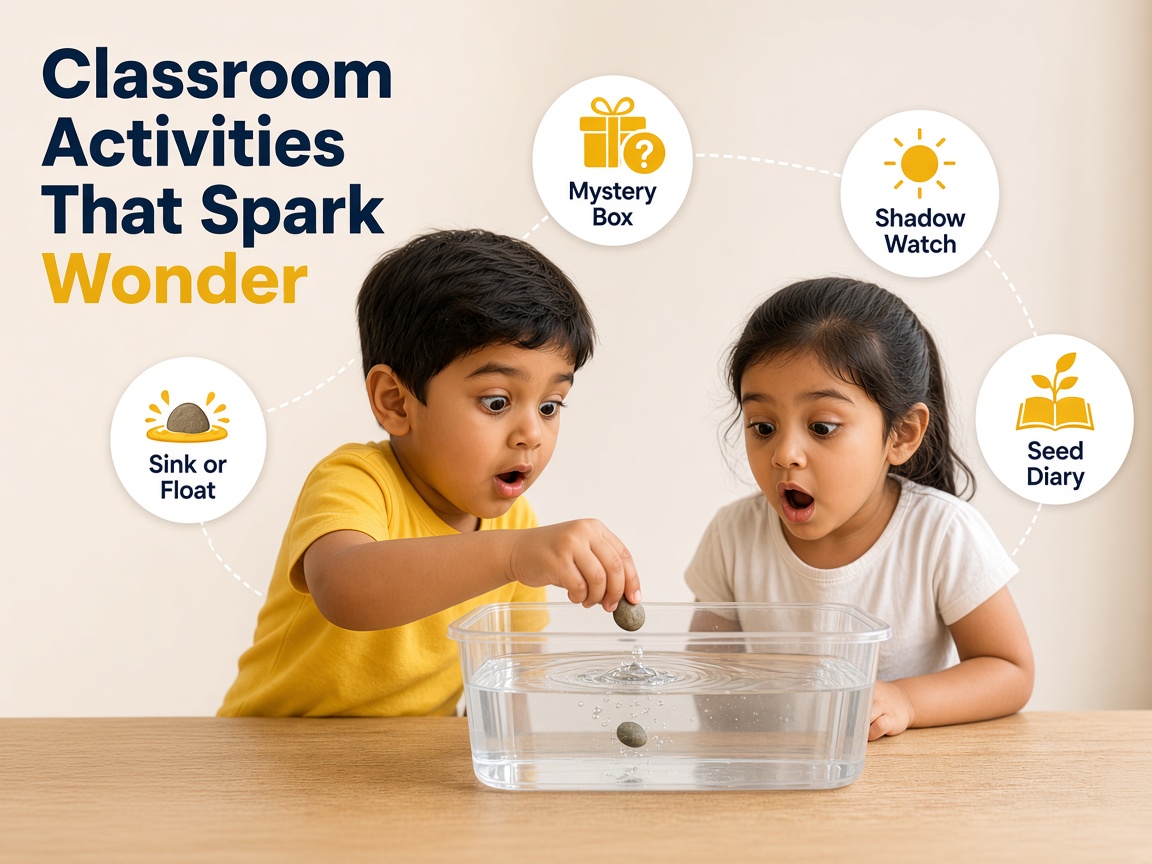
6 Classroom Activities That Spark Wonder
These activities need very few materials and work well with mixed age groups.
1. Sink or Float
Materials: a tub of water, a spoon, a leaf, a stone, a sponge, a plastic lid, a coin.
How: Before dropping each item, ask, “Will it sink or float? Why do you think so?” Record guesses with a tick or cross, then test together.
Ask: “Which one surprised you? Why?”
2. Mystery Box
Materials: a closed box with a hole, one everyday object inside.
How: Let children feel inside without looking and ask yes/no questions to guess the object.
Builds: questioning skills, vocabulary, reasoning.
3. Shadow Watch
Materials: chalk, a sunny spot.
How: Trace a child’s shadow in the morning and again before home time.
Ask: “Why did the shadow move? Where do you think it will be tomorrow?”
4. Seed Diary
Materials: clear plastic cups, cotton or soil, a few beans.
How: Plant beans so roots are visible. Children draw what they see every two days.
Ask: “What changed? What do you think the plant needs?”
5. Nature Hunt with a Mission
How: Go outdoors and ask children to find “something soft”, “something that has fallen” and “something that is alive”. Bring treasures back to the Discovery Table.
Ask: “Where do you think this came from?”
6. Story Pause
How: While reading aloud, stop at an exciting moment.
Ask: “What do you think will happen next? Why do you think so?”
Builds: prediction, listening, language.
A Ready-to-Use Weekly Curiosity Plan
Here is a simple plan you can follow for one week. Each activity takes about 15–20 minutes.
- Monday – Start your Wonder Wall. Ask each child, “What is one thing you wonder about?” and write it down.
- Tuesday – Sink or Float. Record guesses and results on chart paper.
- Wednesday – Nature Hunt. Add findings to the Discovery Table.
- Thursday – Mystery Box. Let children take turns asking questions.
- Friday – Answer two Wonder Wall questions together through a story, a video clip, an experiment or a simple discussion.
Repeat the plan with new themes such as water, animals, weather, our body or things that move.
How to Notice and Record Curiosity
Curiosity is a skill you can observe and encourage. Here are simple signs to look out for:
- Asks “why”, “how” or “what if” questions
- Watches something closely for a long time
- Tries something in a new way
- Makes a guess and checks it
- Shares a discovery with friends
You can note these in your observation records with short lines such as: “Asked why the ice melted faster in the sun. Tested it again with a second cube.” Notes like these are also wonderful to share during parent-teacher meetings.
Sharing Curiosity with Parents
Children carry their questions home, so parents are your partners in keeping curiosity alive. Here is a short note you can send to parents:
“Dear Parents,
This month, our class is exploring the power of ‘why?’. Your child may come home with lots of questions! When they ask, try saying, ‘What do you think?’ before giving an answer. Explore together in the kitchen, the park or the market, and read a story together every day. If your child asks a question you’d like us to explore in class, please write it in their diary. Thank you for helping us raise curious learners!”
Simple tips to share with parents:
- Welcome questions, even on tired days
- Guess and talk before searching for the answer on a phone
- Turn everyday outings into small discoveries
- Read together every day
Bringing It All Together
Every “why?” a preschooler asks is a small seed. With patience, interest and the right classroom, those seeds grow into thinking, reasoning and a genuine love of learning.
As teachers, we don’t need to have every answer. We just need to keep the door to wondering open: listen a little longer, ask a question back, and explore alongside our little learners.
At Caprics Learning Lab, our NEP-aligned curriculum is built around this kind of hands-on, inquiry-led learning, with activity books, teaching aids and teacher training that help every classroom become a place of wonder. To know more, visit capricslearninglab.com or call +91 95001 26622.



Leave a reply