
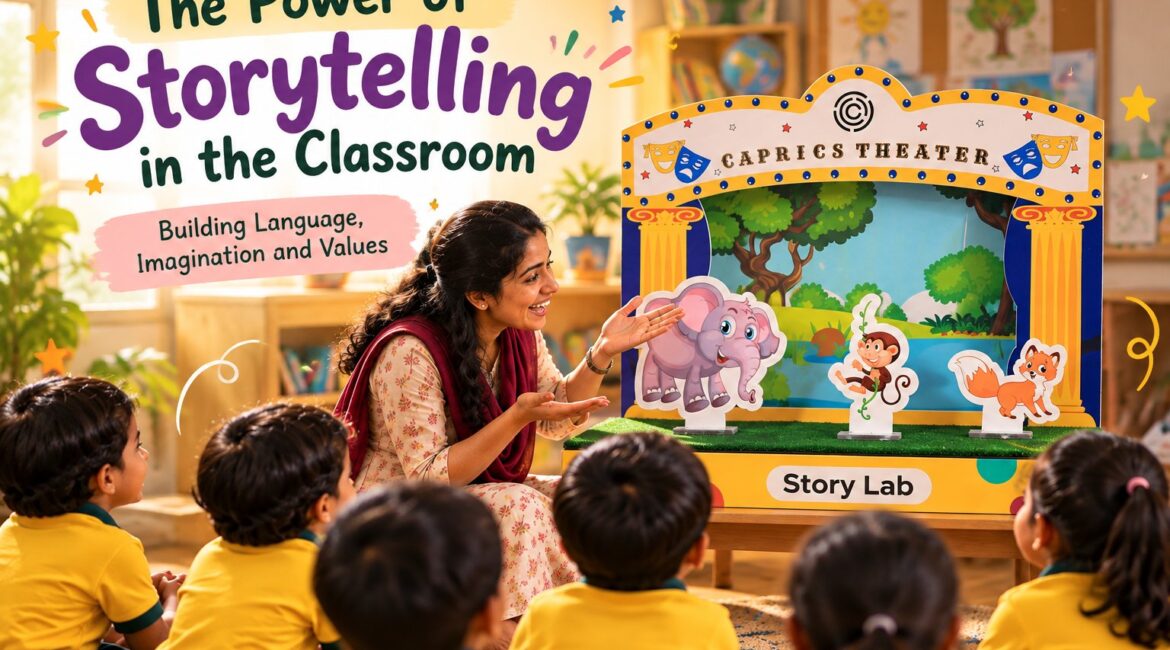

Watch a group of four-year-olds when a teacher says, “Once upon a time…” The fidgeting stops. Eyes lift. Someone shuffles closer. For the next few minutes, the whole room is in another place, following a clever crow or a lost little elephant as if their own lives depended on it.
That moment is not an accident. Storytelling for kids is one of the oldest teaching tools we have, and one of the most powerful. Long before children can read a single word, stories are already building their vocabulary, stretching their imagination and quietly shaping how they see the world. In this article, we look at why storytelling in the classroom matters so much in the early years, and how teachers can use it every day, not just as a Friday treat.
Why Stories Matter So Much in the Early Years
Young children make sense of the world through stories. A story gives shape to experience. It has a beginning, a middle and an end, and children find comfort in that order.
In early childhood education, this natural love of stories is a gift. A story holds a child’s attention far longer than an instruction does. It connects new ideas to feelings, and ideas linked to feelings are remembered. A child might forget a list of animal names, but will remember the thirsty crow who dropped pebbles into the pot until the water rose.
NEP 2020 and the National Curriculum Framework for the Foundational Stage both encourage joyful, play-based and activity-based learning for children aged 3 to 8. Storytelling sits comfortably at the heart of that approach:
- It needs no expensive equipment.
- It works in any language.
- It invites every child to take part, whether they are confident speakers or quiet listeners.
How Storytelling Builds Language and Early Literacy
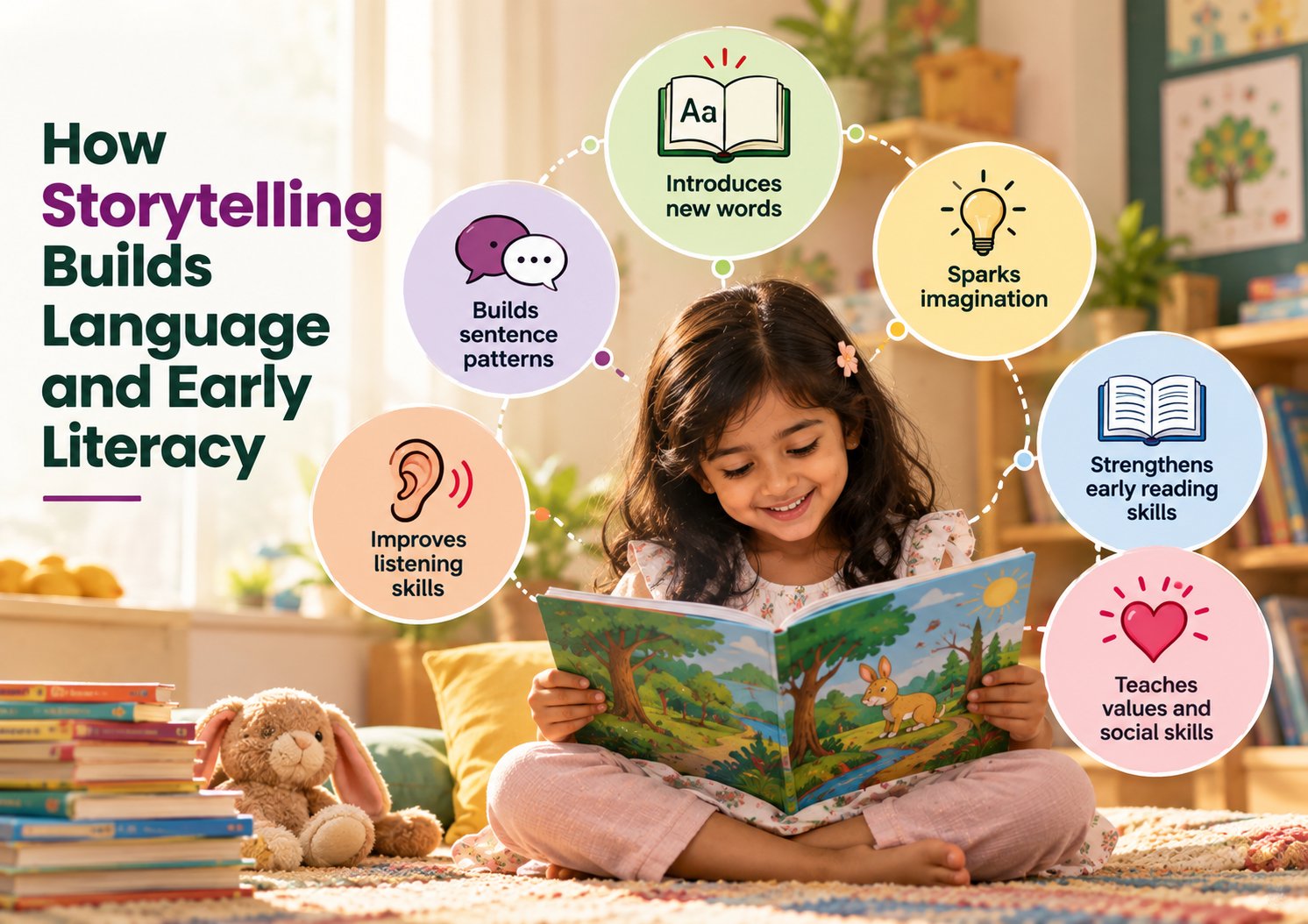
One of the clearest benefits of storytelling is its effect on language development in children. Every story is a rich bath of words, sentence patterns and expressions that children may not hear in everyday conversation.
- New vocabulary in context. Children don’t need a definition of “enormous” or “whisper” when the story shows them what it means. Hearing the same story more than once, which young children love, helps those new words settle into their own speech.
- The structure of language. Children begin to understand how sentences connect, how events follow one another and how a speaker builds suspense. This sense of narrative is an important foundation for reading comprehension later on. A child who knows how stories work finds it much easier to follow a written text.
- Stronger listening skills. Following a story requires children to hold information in their minds, predict what might happen next and notice details. These are the same skills they will need for foundational literacy in Grade 1 and Grade 2.
Retelling is where the magic multiplies. When children are invited to retell a story in their own words, act it out or change the ending, they move from listening to speaking. They practise new words, build sentences and gain the confidence to express themselves in front of others. For children learning English as a second or third language, this kind of playful, low-pressure speaking practice is especially valuable.
Imagination, Creativity and Thinking Skills
A good story asks children to see what isn’t there. A forest, a talking rabbit, a ship on a stormy sea. With no screen doing the work for them, children build these pictures in their own minds. That act of imagining is a powerful mental exercise.
Imagination is not just about fantasy. It is the ability to think beyond what is in front of you, to picture possibilities and to solve problems in new ways. Children who are used to imagining are often better at creative play, at inventing games and at coming up with their own ideas.
Stories also build early thinking skills. Simple questions from the teacher are the beginnings of critical thinking:
- “What do you think the little bird should do now?” helps children predict, reason and make choices.
- “Why did the fox say that?” gets them thinking about motives and consequences.
And when children create their own stories, whether by drawing, using puppets or telling them aloud, they become authors. They decide who the characters are, what problem they face and how it gets solved. Few activities give a young child such a strong sense of ownership and pride.
Teaching Values and Emotions Through Stories
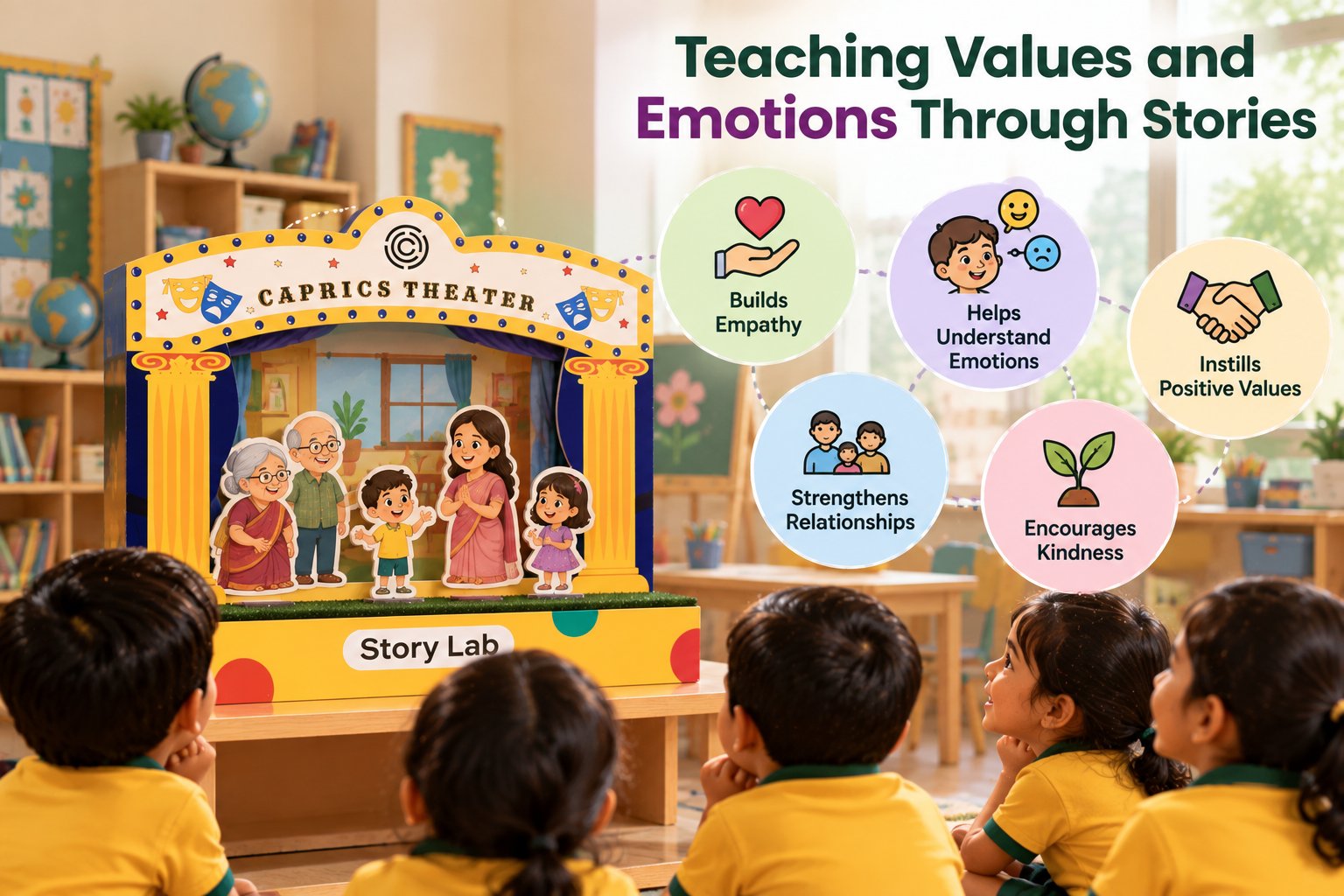
Some of the most important lessons in early childhood are not about letters or numbers. They are about kindness, honesty, patience, sharing and courage. Moral stories for kids have carried these lessons across generations, from the Panchatantra and Jataka tales to the folk stories every grandparent seems to know.
Stories teach values without lecturing. Telling a child “Don’t lie” rarely lands. Telling them the story of the boy who cried wolf, and watching their faces when no one comes to help him, leaves a much deeper mark. Children draw the lesson themselves, and a lesson they discover feels like their own.
Stories are also one of the best tools for social and emotional learning. Through characters, children meet feelings they may not yet have words for: jealousy, fear, loneliness, excitement, pride. A teacher can pause and ask, “How do you think she felt when her friends left her out?” This helps children name emotions, recognise them in others and slowly build empathy.
Stories can also help with real classroom situations:
- If children are struggling to share toys or take turns, a simple story about two friends who learned to share can open a gentle conversation.
- If a child is nervous about a new baby at home or starting a new class, a story about a character going through the same change can be deeply reassuring.
Practical Storytelling Activities for the Classroom
Storytelling doesn’t need to be a separate subject. It works best when it is woven through the whole day. Here are some simple preschool storytelling activities teachers can try.
- Story circle. Begin or end the day with a short story in a circle. Keep it consistent so children look forward to it. Use your voice, pauses and facial expressions to bring the characters alive.
- Picture walks. Before reading a picture book, flip through the pages and let children guess what the story might be about. This builds prediction and vocabulary before a single line is read.
- Puppets and props. Simple finger puppets, soft toys or even paper cut-outs make stories visual and hands-on. Invite children to hold the puppets and speak for the characters.
- Story sequencing cards. After a story, give children three or four picture cards and ask them to arrange them in order. This strengthens memory, sequencing and retelling.
- Change the ending. Ask, “What if the crow couldn’t find any pebbles?” Let children invent new endings. There are no wrong answers, only new ideas.
- Act it out. Turn a favourite story into a short role-play. Children practise language, movement and confidence all at once.
- Story and art. After a story, let children draw their favourite scene or character. Ask them to describe their drawing, building speaking skills alongside creativity.
- Home stories. Invite parents to share a story from their own childhood or culture. This builds a strong bond between home and school and adds variety to the classroom.
The key is repetition and participation. Young children love hearing the same story many times, and each retelling deepens their learning.
How Caprics Learning Lab Brings Storytelling to Life
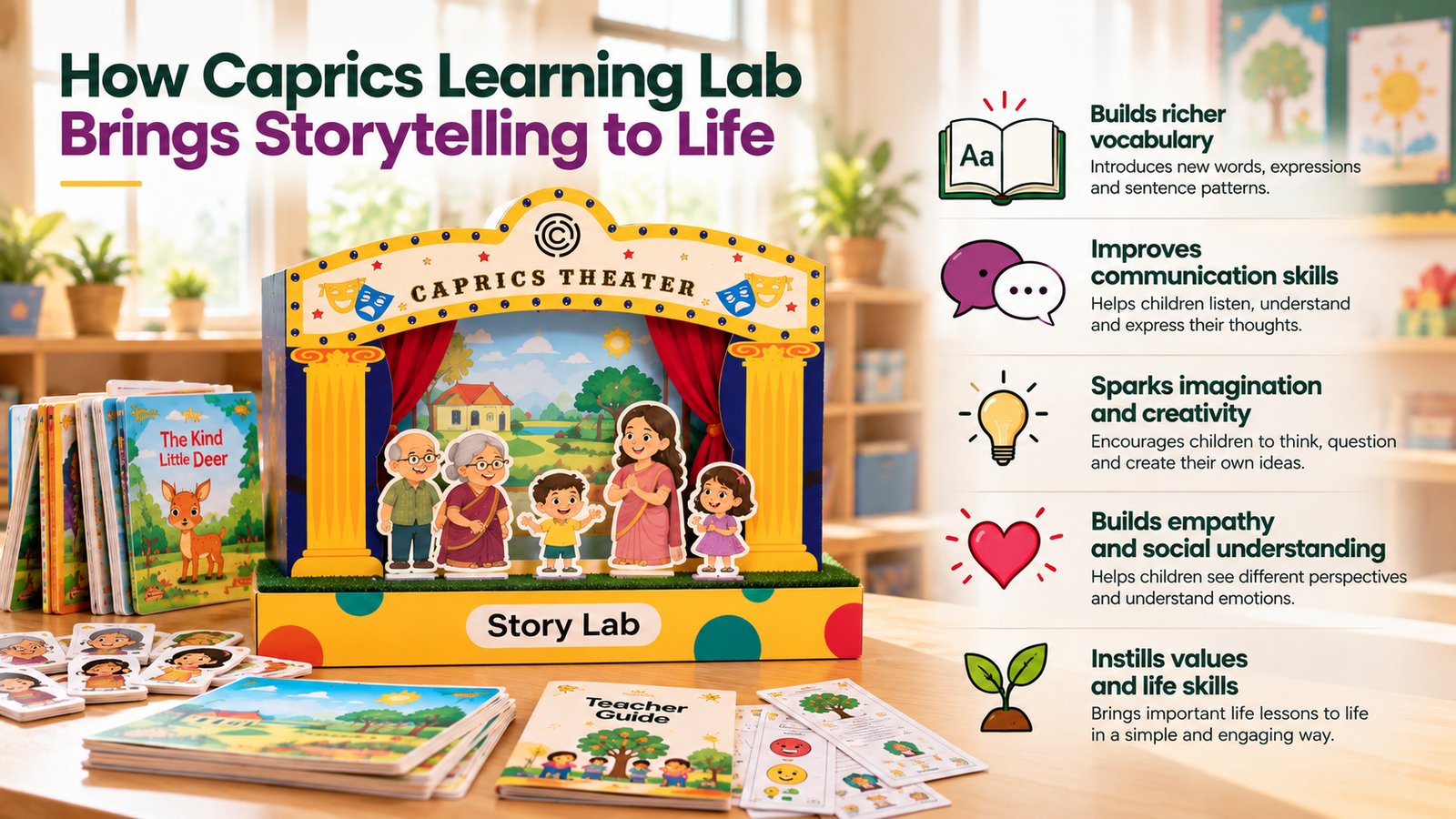
At Caprics Learning Lab, we believe stories belong at the heart of the early years classroom. That is why storytelling runs through our NEP-aligned curriculum for Playgroup to Grade 2, rather than sitting on the side as an extra activity.
Our Story Lab programme is designed to help teachers use stories to build language, imagination and values in a planned, joyful way:
- Stories are linked to themes children are already exploring, so a story about animals or seasons connects naturally to the rest of the day’s learning.
- Activities for listening, retelling, role-play, art and discussion are built into the lesson plans, so teachers never have to wonder what to do after the story ends.
- Our student books, activity books and teaching kits support this with visual materials, story cards and hands-on tasks that help children engage with each story in different ways.
- Through our teacher training, educators learn practical storytelling techniques, from using their voice and expressions to asking the right questions that spark thinking and conversation.
The result is a classroom where stories are not just heard, but lived. Children become better speakers, more confident listeners, more imaginative thinkers and kinder friends, one story at a time.



Leave a reply