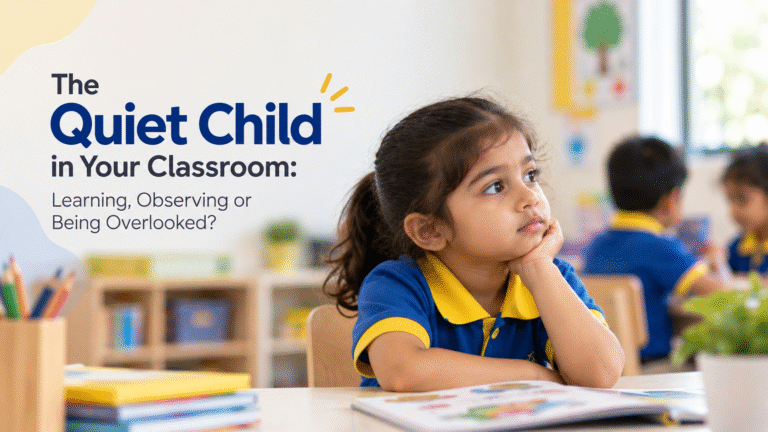
In every classroom, there is often a child who doesn’t raise their hand first.
They don’t rush to the front when an activity begins. They may sit quietly during circle time, watch other children play, or take a little longer to respond when the teacher asks a question.
While some children are eager to talk, ask questions, and show everyone what they have made, the quiet child may simply watch.
It is easy to assume that the child is shy, not interested, or not participating.
But what if we are looking at it the wrong way?
Is the child really not participating, or are we just not recognizing the way they participate?
In early childhood classrooms, learning doesn’t always look like speaking up, answering quickly or being the first to finish an activity. Some children need time to observe, process and understand before they join in.
The important question for a teacher isn’t, “Why is this child so quiet?”
It is, “What is this child telling me through their behaviour?”
A Quiet Child May Be Learning More Than We Think
We often associate an active classroom with an active learner.
The child who answers every question, talks to friends and eagerly joins activities is easy to notice. But learning can also happen quietly.
Imagine a teacher giving children blocks and asking them to build a bridge.
One child immediately starts building.
Another child sits and watches.
They watch how the blocks are placed. They notice when another child’s bridge falls. They pick up a block, try something, change it and try again.
From the outside, the child may have looked disengaged at first.
In reality, they were observing, thinking and working out what to do.
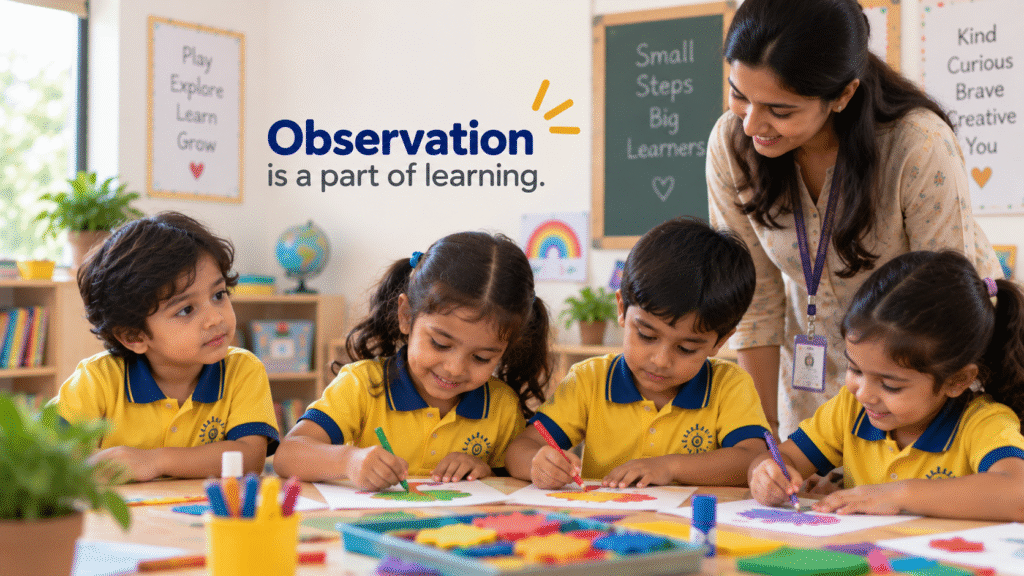
Observation is a part of learning.
Young children often learn by watching others before trying something themselves. Some need more time to process an instruction. Some prefer to understand an activity before becoming involved.
This is why teachers need to look beyond visible participation.
Instead of asking only, “Did the child participate?”, it helps to ask:
- What was the child observing?
- Did they understand the instruction?
- How did they respond to the activity?
- Do they participate differently in a smaller group?
- How do they communicate their ideas?
- What activities naturally draw their attention?
A quiet child may not be less engaged.
Their engagement may simply be less obvious.
Quiet, Shy or Disengaged? They Are Not the Same
Not every quiet child is a shy child.
And not every shy child is struggling.
A child may be naturally reserved and still feel completely comfortable in the classroom. Another may need more time to feel comfortable around new people. Some children prefer talking to one friend rather than speaking in front of twenty classmates.
There can also be children who are genuinely disengaged or finding something difficult.
These situations may look similar at first, but they need different responses.
This is where child observation in early childhood education becomes important.
Rather than quickly labelling a child as “shy” or “not interested”, teachers can look for patterns.
For example, instead of writing:
“Riya doesn’t participate.”
A more useful observation might be:
“Riya watches during group discussions but responds confidently when spoken to individually. She participates actively during drawing and construction activities.”
That small difference matters.
The first statement becomes a label.
The second gives the teacher something to work with.
It tells us that the child can participate. Perhaps the setting, activity or size of the group makes a difference.
Good observation helps teachers understand when, where and how a child feels most comfortable learning.
And once we understand that, we can create better opportunities for participation.
The Quiet Child Can Easily Become the Overlooked Child
There is another challenge in a busy preschool classroom.
The children who need attention often get it first.
One child is calling the teacher.
Another needs help with an activity.
Two children are arguing.
Someone has spilled their water.
Another child is excitedly showing the teacher a drawing.
In the middle of all this, a quiet child may be sitting calmly and completing their work.
Because they aren’t asking for help or creating a problem, the teacher may naturally spend less time with them.
This isn’t intentional neglect. Teachers are constantly managing competing needs.
But over time, quiet children can become easy to overlook.
Their silence can create the impression that everything is fine.
That’s why teachers can make a conscious effort to check in with them.
It doesn’t have to be a big conversation.
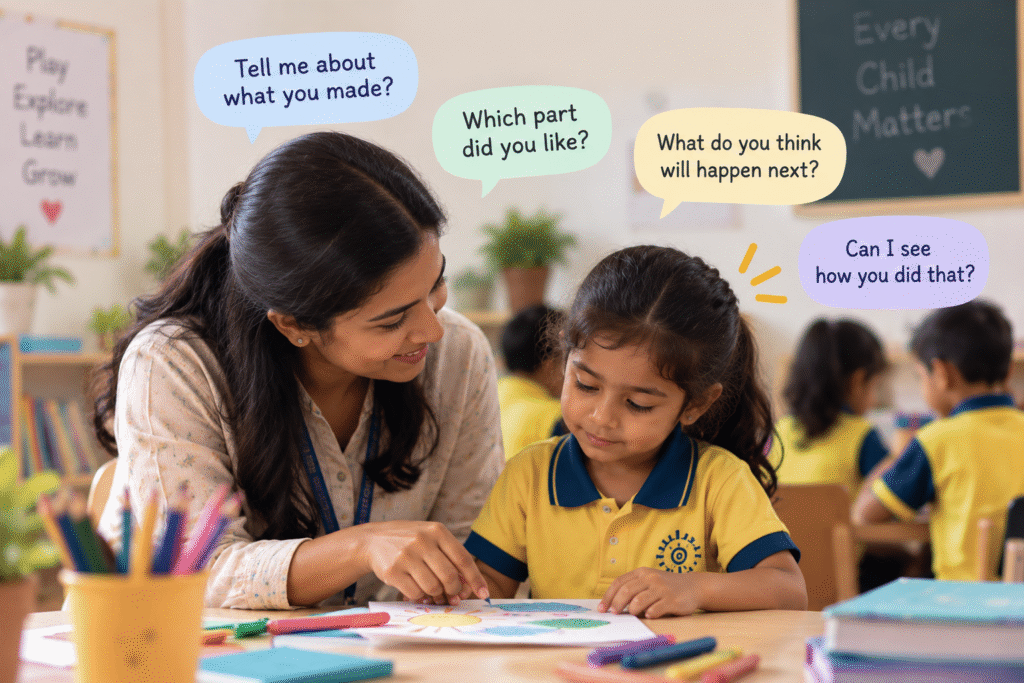
A simple:
“Tell me about what you made.”
“Which part did you like?”
“What do you think will happen next?”
or even
“Can I see how you did that?”
can open a door.
And importantly, the child doesn’t have to answer in front of the whole class.
They might show the teacher instead.
They might point.
They might draw.
They might explain it later.
Participation doesn’t have to mean speaking loudly in front of everyone.
Don't Force a Quiet Child to Become a Loud Child
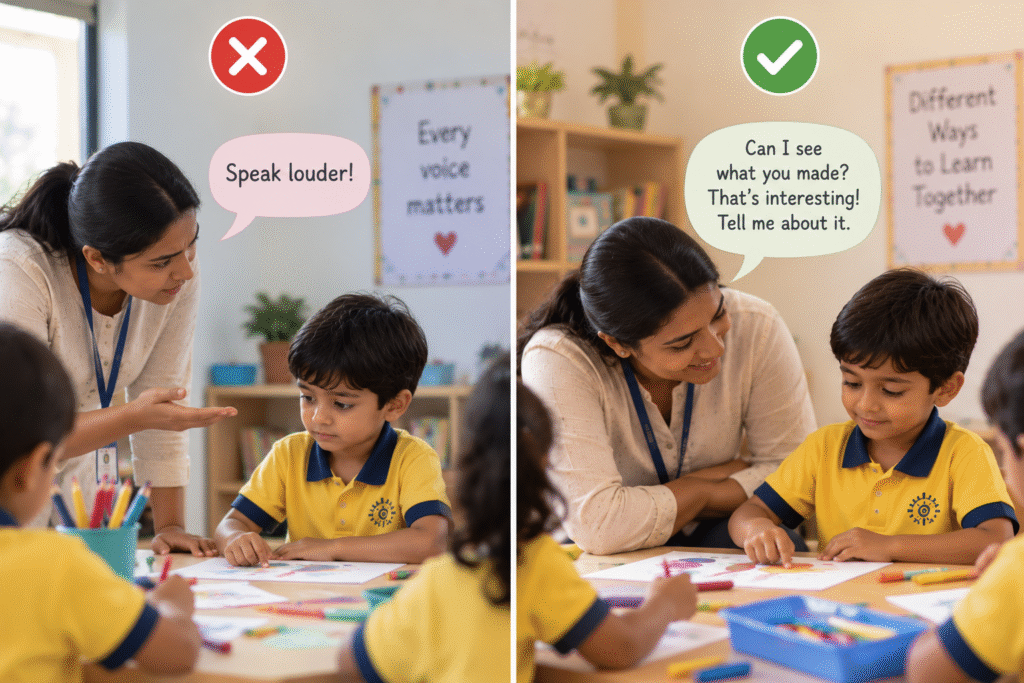
One of the easiest mistakes adults can make is trying to “fix” quietness.
“Speak louder.”
“Why don’t you answer?”
“Don’t be shy.”
“Come on, everyone else is participating.”
These comments may be said with good intentions, but repeated pressure can make a child even more uncomfortable.
The better approach is to create comfortable entry points into participation.
Start with pairs or small groups. A child who rarely speaks during whole-class discussions may have plenty to say when working with one friend.
Give children thinking time. Not every child can process a question and formulate an answer immediately.
Use hands-on activities. Building, sorting, drawing, role-play and movement give children different ways to express what they understand.
Give choices. Instead of asking an open question that feels overwhelming, offer two or three possibilities and let the child respond.
Most importantly, build trust.
A child who knows that their teacher will listen without rushing or judging them is more likely to communicate.
The goal isn’t to turn a quiet child into the most talkative child in the room.
The goal is to help them feel comfortable enough to participate in their own way.
Watch What the Quiet Child Does, Not Just What They Say
Sometimes the most useful information about a child comes from watching them during ordinary classroom moments.
A child who rarely speaks during circle time may spend twenty minutes carefully building a structure.
A child who doesn’t answer questions may remember exactly where a particular object was kept.
A child who stays quiet in a group may become the leader during pretend play.
Another may communicate beautifully through drawings.
These moments tell us something.
Children communicate through actions as well as words.
Play, in particular, can reveal a great deal about children’s learning and development.
A child arranging objects may be developing mathematical thinking.
A child creating a pretend shop may be using language, imagination and social skills.
A child solving a problem with blocks may be developing persistence and reasoning.
This is why observation is such a valuable part of early childhood assessment.
Not everything a child knows will appear on a worksheet.
Not everything they understand will come out as a spoken answer.
Sometimes, you have to watch the child at play to see the learning.
For teachers, this means moving beyond the question:
“Why isn’t this child talking?”
and asking:
“What is this child communicating through what they are doing?”
That change in perspective can make a significant difference.
Every Child Deserves to Be Seen
A good classroom isn’t one where every child behaves in the same way.
Some children will be naturally expressive. Some will ask endless questions. Some will jump into every activity. Others will watch first and join later.
That difference is not necessarily a problem.
The role of an early childhood educator is not to make every child identical. It is to understand their individual ways of learning and create an environment where each child can feel safe, capable and included.
So, the next time you notice a quiet child sitting at the edge of an activity, pause before assuming they aren’t interested.
Look a little closer.
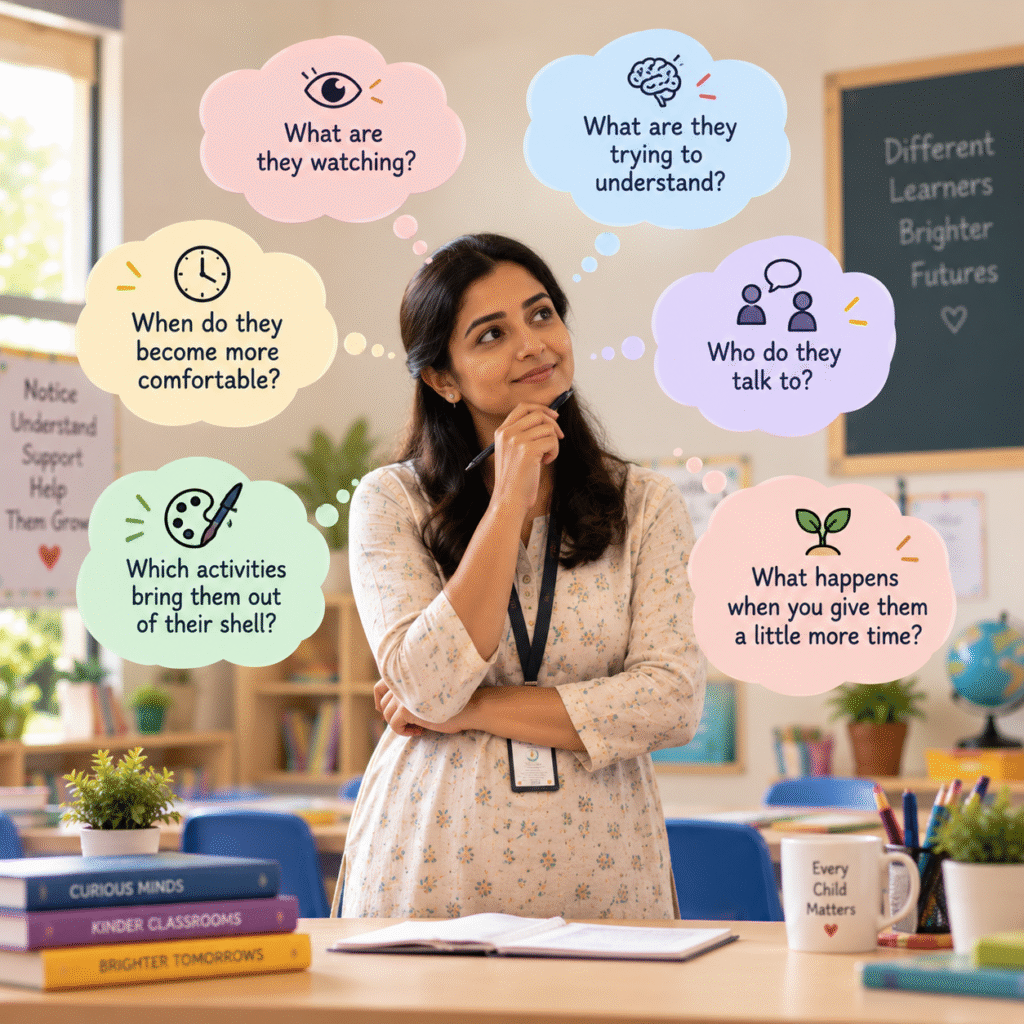
What are they watching?
What are they trying to understand?
When do they become more comfortable?
Who do they talk to?
Which activities bring them out of their shell?
What happens when you give them a little more time?
Sometimes, the child who says the least may be noticing the most.
And sometimes, the difference between being quiet and being overlooked is simply whether someone takes the time to notice.
A Thought for Every Teacher
Every classroom has children whose learning is easy to see—and children whose learning asks us to look a little closer.
Good teaching isn’t just about noticing who raises their hand. It’s about noticing who is thinking, observing, experimenting, connecting and learning, even when they aren’t saying a word.
Because every child deserves more than a place in the classroom.
They deserve to be seen.