A recent change in the Class 8 NCERT Social Science textbook brings an interesting shift in how the judiciary is presented to students.
Instead of limiting the discussion to how courts are supposed to function, the book also introduces real challenges corruption at different levels, shortage of judges, and the growing backlog of cases. Even references to complaints filed through official grievance systems are included, but in a calm and balanced manner.
What stands out is not just what is included, but how it is presented. The tone remains measured. Problems are acknowledged without creating alarm, and at the same time, efforts by governments to improve transparency, adopt technology, and address these issues are also highlighted.
This raises an important thought: how should young minds be introduced to institutions like the judiciary?
Should education focus only on the ideal structure, the way the system is designed to work? Or should it also include the realities that shape its functioning?
There is often a concern that exposing students to such challenges too early might lead to doubt or cynicism. However, presenting only a perfect picture may leave them unprepared for the complexities of the real world.
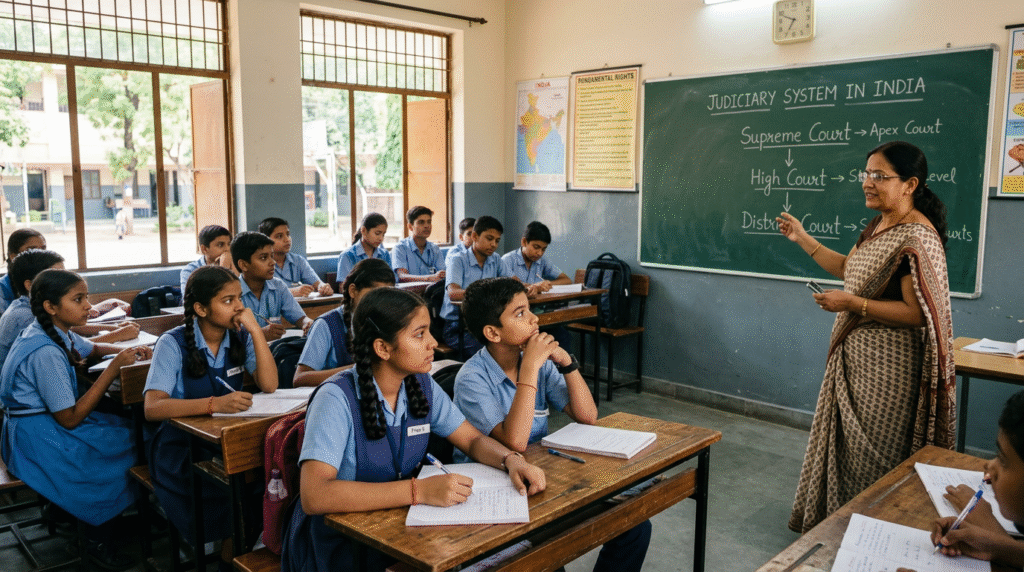
Perhaps the answer lies in balance.
When students are shown both the ideals and the realities along with the efforts being made to bridge the gap they gain a more grounded understanding. Instead of weakening trust, this approach can encourage awareness, critical thinking, and a sense of responsibility.
After all, institutions are not fixed—they evolve. And education plays a role not just in explaining systems, but in shaping individuals who may one day improve them.
In that sense, honesty in teaching does not take away hope—it strengthens it.
More Than a Structure on Paper
For many years, Social Science education has focused mainly on structure.
What is the judiciary?
How many levels of courts are there?
What does each court do?
Students memorise the hierarchy. They learn definitions. They prepare for exams.
But is that enough?
If children only learn how systems are supposed to function, without understanding that real systems are run by real people, we create a gap between textbook knowledge and lived reality. When they later encounter news about delays or corruption, it feels like something hidden from them.
Education should not feel like that.
Children Understand More Than We Think
By the time students reach middle school, they are already more aware of the world than we often assume. They listen to conversations at home. They hear adults discussing news events. They see headlines on television or online. Many of them also come across discussions on social media, even if they do not fully understand every detail.
Because of this constant exposure, children slowly begin to form their own understanding of how society works. They notice when people talk about delays in courts, questions of fairness, or problems within systems. Even if they cannot explain these issues clearly, they know that the world around them is not always perfect.
When textbooks completely avoid mentioning challenges, students often sense that something is missing. The silence can make learning feel incomplete. In some cases, it may even create confusion. If what they hear outside the classroom feels very different from what they read in their books, they may begin to question the relevance of what they are being taught.
This is why honest and balanced discussions are important in education. When educators acknowledge challenges in a thoughtful and responsible way, it does not weaken a student’s trust in institutions. Instead, it helps them understand that systems are created by people and are always evolving.
Such conversations can also help students develop empathy and critical thinking. They begin to understand that institutions are built on strong principles like justice and fairness, but they can still face difficulties in practice. More importantly, they learn that societies constantly work towards improvement through reforms, accountability, and participation.
When students are introduced to these ideas gradually and carefully, they begin to see institutions not as distant or untouchable structures, but as systems that can grow, change, and improve over time. This understanding encourages them to think more deeply about their role as future citizens.
Instead of becoming cynical, students often become more curious and engaged. They start asking thoughtful questions and trying to understand how systems can function better. In this way, education does more than provide information. It encourages young learners to observe the world around them with awareness and responsibility.
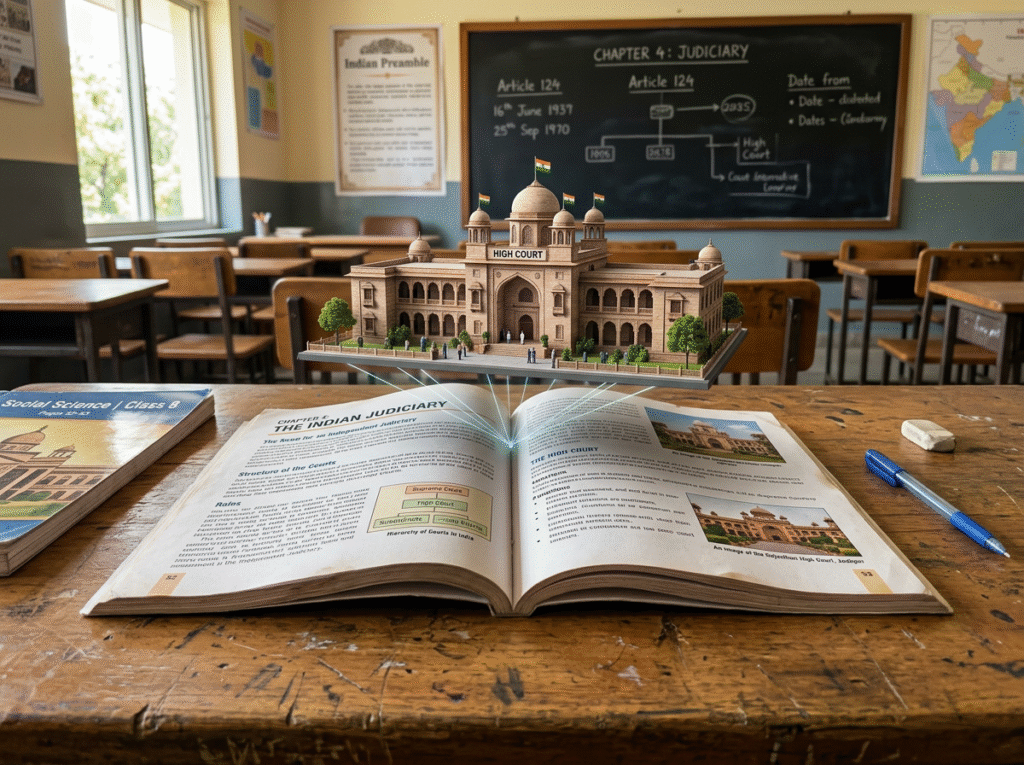
Will Awareness Make Students Negative?
This is often the biggest concern.
If we talk about corruption or case backlogs, will children lose faith in the judiciary?
But think about it differently.
If we present institutions as flawless and later students discover the real complexities, the disappointment may be deeper. Honest education builds resilience. Incomplete education builds shock.
The key lies in balance.
When challenges are discussed alongside solutions, students see a fuller picture. They understand that problems exist, but efforts are constantly being made to solve them. They begin to see governance as a work in progress rather than a broken system.
That understanding builds engagement, not negativity.
The Importance of Age Appropriate Framing
This does not mean we should overload young children with serious or complicated topics.
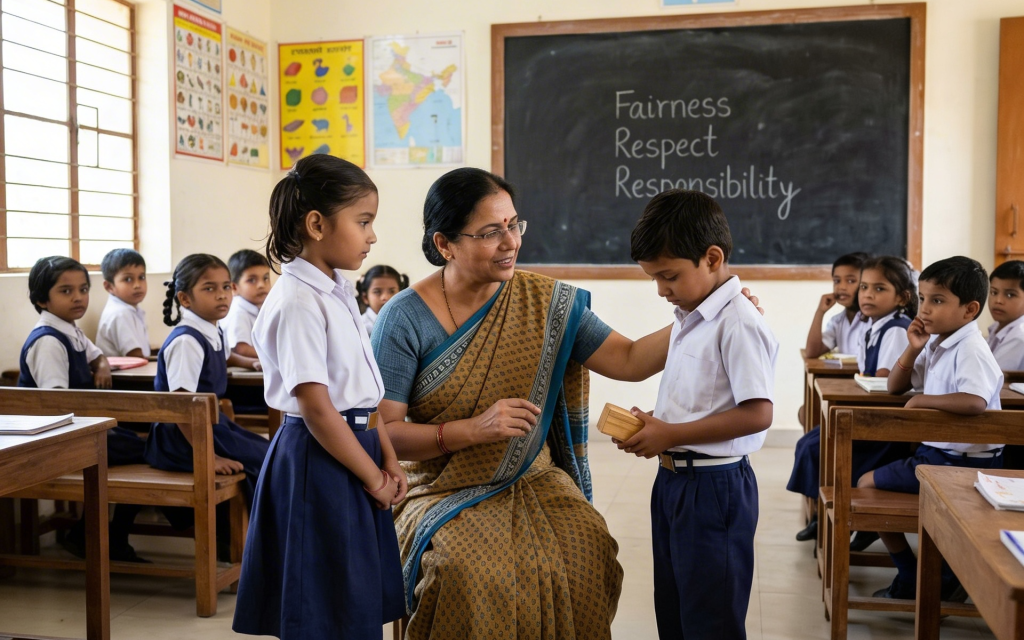
In pre primary and early primary classes, civic learning starts with very simple ideas. Fairness. Sharing. Waiting for your turn. Saying sorry. Following rules. These small lessons are the first steps toward understanding bigger systems later in life.
As children grow older, we can slowly introduce larger concepts. What is a court? Why do we need judges? What happens when someone breaks a rule? Why do some cases take time? How can things be improved?
Learning should grow along with the child.
Curriculum is not just about giving information. It is about building understanding step by step. When topics become deeper gradually and are explained with care, children do not feel confused or stressed. Instead, they feel respected and included in meaningful conversations.
Teaching Values, Not Just Information
When we teach about the judiciary, the goal is not only to explain courts and procedures.
It is to nurture values.
Justice. Responsibility. Integrity. Accountability.
If a child understands that corruption is wrong and also understands why transparency matters, the lesson becomes meaningful. Instead of thinking that systems are flawed and beyond repair, they may begin to think about how they can contribute to change in the future.
That is powerful.
Education should not create passive observers. It should encourage thoughtful participants.
Numbers That Tell a Story
The textbook mentions that more than 1,600 complaints were received through CPGRAMS between 2017 and 2021. At first glance, this may seem like just another statistic. But for students reading the chapter, it carries an important message.
It shows that grievances can be recorded and acknowledged. It tells students that citizens have a voice and that systems exist where concerns can be raised. It also reminds them that institutions are constantly being observed and evaluated.
Numbers like these make governance feel more real. Instead of being abstract ideas written in textbooks, institutions start to appear as working systems that interact with people’s lives.
For students, this can be a powerful realization. They begin to understand that society is not only shaped by leaders and officials, but also by ordinary citizens who ask questions, raise concerns, and participate in improving systems.
When young learners see how numbers reflect real actions and responses, they start to see themselves as future citizens who can observe, question, and contribute responsibly to the society around them.
What Should Responsible Education Look Like?
So where do we draw the line?
Should textbooks only present the ideal version of institutions? Or should they also present the realities?
Perhaps responsible education includes both.
Teach how the system is designed.
Acknowledge where it struggles.
Explain what is being done to improve it.
Encourage students to think and ask questions.
When education does this, it builds trust rooted in understanding, not blind belief.
And maybe that is the real purpose of Social Science education. Not just to help students score marks, but to help them grow into aware and responsible individuals.
A Thought for Educators and School Leaders
As educators and curriculum designers, these questions stay with us.
How much complexity is appropriate for a child’s age?
How do we stay hopeful without ignoring reality?
How do we build trust while still encouraging children to think independently?
Curriculum is never just about completing chapters. The ideas introduced in the early years quietly shape how children see the world as they grow. The way we talk about institutions, fairness, responsibility and accountability leaves a lasting impression.
If we can help children understand that systems can evolve, that improvement is always possible and that every citizen has a role to play, then we are doing something far more meaningful than finishing a syllabus. We are helping shape thoughtful, responsible future citizens.
CONCLUSION
In the end, education is not only about helping children understand how systems work. It is about helping them understand their place within those systems. When students learn about institutions like the judiciary with honesty and clarity, they begin to see that society is built on both rules and responsibility.
At a young age, children may not fully understand courts or legal procedures. But they can understand ideas like fairness, honesty, and accountability. These small lessons become the foundation for bigger civic understanding later in life.
When education introduces these ideas gradually and thoughtfully, students do not feel overwhelmed. Instead, they feel curious. They begin asking questions. They start connecting what they learn in books with what they observe in the world around them.
This is where real learning begins.
The goal is not to make children experts in law. The goal is to help them grow into individuals who value fairness, respect systems, and believe they can contribute to improving them. When learning encourages curiosity and reflection, students do not just study society. They begin to understand how they can be a part of shaping it.