Education today is under immense pressure. Parents are demanding real learning outcomes, not just grades. Teachers are seeking clarity in a crowded syllabus. And students? They need confidence, not confusion.
This is where Competency-Based Education (CBE) changes the game.
Unlike the traditional “one-size-fits-all” approach, CBE focuses on what students can actually do with what they learn. It shifts the goalpost from “finishing the syllabus” to “mastering the skill.”
Here is why schools across India and the world are urgently adopting this model to drive deeper understanding and stronger academic results.
What Is Competency-Based Education?
At its core, Competency-Based Education is a learning approach where progress depends on mastery, not seat time.
In a traditional classroom, a student moves to the next chapter because the calendar says so. In a CBE classroom, students move ahead only when they show a clear, demonstrated understanding of the concept.
Broken down into Competencies: Subjects aren’t just chapters; they are specific skills and knowledge blocks.
Step-by-Step Mastery: Students climb the ladder of learning one firm step at a time.
Meaningful Assessment: Grades reflect actual ability, not just an average of test scores.
Why Traditional Education Often Falls Short
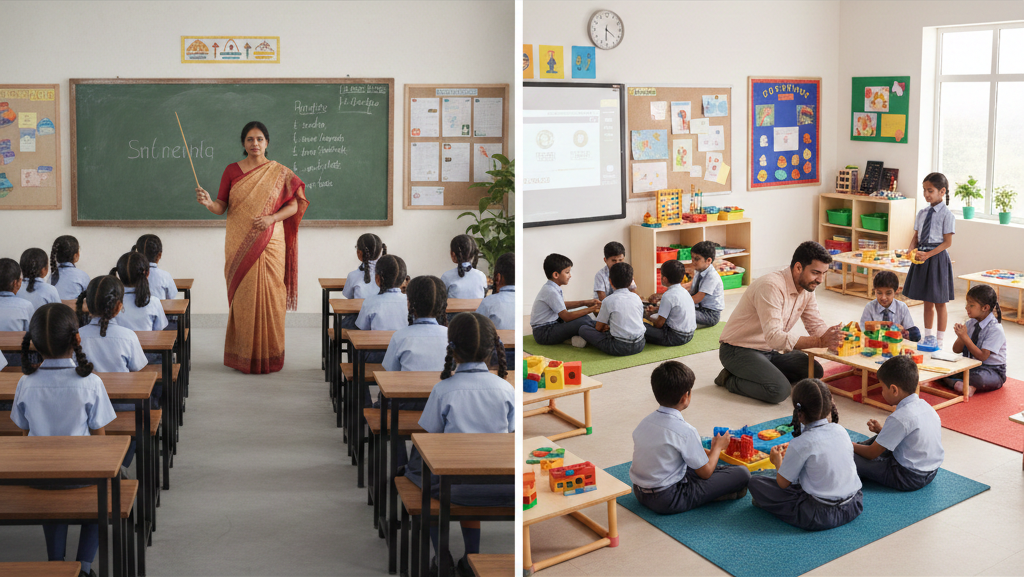
Traditional education follows a fixed pace. All students move forward together, even if some are confused. Lessons continue because the calendar demands it.
Exams often test memory instead of understanding. Students may pass without mastering basics. Over time, learning gaps grow.
Teachers feel rushed. Students feel pressured. Learning becomes about completion, not comprehension.
Competency-Based Education addresses these problems by changing how progress is measured.
How CBE Works Inside the Classroom
Implementing this requires a shift in mindset, but the process is logical:
Clear Learning Goals: Students know exactly what they need to achieve before the lesson starts.
Targeted Instruction: Teachers design lessons around specific skills (e.g., “Critical Thinking in History” rather than just “Chapter 4”).
Real-Time Support: If a student struggles, they get immediate help. If they master it early, they move to advanced topics.
This balance makes learning effective, ensuring no child is left behind and no advanced learner is bored.
Ways That Competency-Based Education Benefits Your School Community
For Students: Confidence & Clarity
Stronger Concept Mastery: No moving forward with shaky foundations. Students truly learn before they progress.
Higher Motivation: When learning happens at the right pace, stress drops and confidence soars.
Real-Life Skills: It builds the “4 Cs”—Critical thinking, Communication, Collaboration, and Creativity—essential for life beyond school.
For Teachers: Focus & Effectiveness
Laser-Focused Planning: Teachers know exactly what mastery looks like, making lesson planning sharper.
Actionable Feedback: Instead of just giving a grade, teachers can pinpoint exactly where a student needs help.
For Schools: Reputation & Results
Consistent Outcomes: Academic performance improves across the board as learning gaps disappear.
Future-Ready Branding: Adopting CBE aligns your school with global best practices and progressive policies like NEP 2020.
The Role of Technology in CBE
Technology doesn’t replace the teacher; it empowers them.
In a Competency-Based model, digital tools helps track individual mastery levels. Learning Management Systems (LMS) allow students to revisit lessons they found difficult and practice independently. This data gives School Leaders the insights they need to make better academic decisions.
Challenges & The Path Forward
Transitioning to CBE isn’t an overnight switch. It requires:
Redesigned curriculum and assessment systems.
Teacher training to shift from “lecturing” to “facilitating.”
Parent orientation to explain why “mastery” matters more than “ranks.”
However, schools that make this shift find that the long-term benefits—confident students and happy parents—far outweigh the initial effort.
Final Thoughts
Competency-Based Education is more than a buzzword; it is a necessary evolution. It shifts the focus from time to understanding, and from memorizing to mastering.
By aligning teaching with clear outcomes, schools create a generation of learners who are not just ready for exams, but ready for the world.